



Story by Lt. Col. Tinagay Riddle, Kentucky National Guard Diversity Initiatives Advisor
A 'lens' is a way to frame or think about the world around us. An easy way to visualize this would be to think about it in terms of colors. If you have ever used yellow lensed glasses for driving at night (helps reduce glare), it colors the way we actually see and experience the world. The cycle is composed of five parts that have been repeatedly recognized in educational research as important, yet often implicit, components of learning (Schwartz et al., 1999). IRIS STAR Legacy Modules incorporate these five components, balancing the four HPL lenses. The Four Lenses is a proven personality temperament model that acts as a universal companion to any training or initiative. This foundational training helps individuals and organizations establish a common language and value system for diverse perspectives and unique talent in the workplace, in.
Four Lenses training is designed to improve teambuilding skills and better prepare troops for deployment. (Photo by: Sgt. David Bolton, Public Affairs Specialist, 133rd Mobile Public Affairs Detachment, Kentucky Army National Guard)
FRANKFORT, Ky. – Many wonder, what is this “diversity” that we keep hearing about? Is that just a new fangled word for equal opportunity or affirmative action – will it only benefit minorities or women?
In the primary sense, all diversity means is differences. In a human resource context, diversity refers to human qualities that are different from our own and those of groups to which we belong; but that are manifested in other individuals and groups. Dimensions of diversity include but are not limited to: age, ethnicity, gender, physical abilities / qualities, race, sexual orientation, educational background, geographic location, income, marital status, military experience, parental status, religious beliefs, work experience, and job classification.
So, diversity focuses on a broader set of qualities than race and gender. In the context of the workplace, valuing diversity means creating a workplace that respects and includes differences, recognizing the unique contributions that individuals with many types of differences can make, and creating a work environment that maximizes the potential of all employees.
How do we go about that? Well, we start by heightening our own awareness of individual preferences, styles and behaviors. This allows us to gain a deeper insight into how our own personal preferences thus, style impacts our relation to others, to a team, and to the organization. It also allows us to perceive potential conflict. We then may see differences with this amusement – how, with so many differences that exist within individuals, could we possibly think that we would react, behave, interact and relate in the same ways?
Diversity in the National Guard goes beyond race and gender — it includes military, civilian, family and veterans. (Kentucky National Guard photo by Sgt. Scott Raymond)

The Four Lenses Discovery Workshop is an approach to temperament theory that instantly creates a sense of understanding and involvement. Classifying humanity into specific personality types is an idea that has been around for centuries. It has been found in the writings of the ancient Egyptians, Europeans, American Indians, and Greeks. In the early 1900s, the study of personality became more scientific. Carl G. Jung, a Swiss psychologist developed a way of interpreting preferences into personality type with some functions dominant within the individual than others. This idea was further perfected for interpretation and application by Katharine Briggs and her daughter, Isabel Briggs Myers in 1942. In 1962, this psychometric, the Myers/Briggs Personality Type Indicator, was finally published and has been used and elaborated on extensively. Simplified and condensed in 1978, by another psychologist, Dr. David Keirsey; he reduced it down to four basic personalities and called them temperaments. Four Lenses is based on the temperaments with each temperament symbolized by a color for ready identification and applicability.
Last year nine Army and six Air Guard members were qualified to administer this fun, thought provoking, and team building class. The Four Lenses process does not limit us to any one preference – variety is endless. It is not to pigeon hole, but to help us realize that we all have traits of each other; though we all have differing comfort levels with various aspects of personality. It is most important to realize that real strengths lie in the areas with which we are most comfortable and real learning occurs when we become more self aware.
Four Lenses could begin lifelong learning about aspects of oneself that, many times, is not individually challenged, but which could lead to more strength and professionalism of self; more respect and appreciation for others; and everyone can use improvement in the area of relationship. Team, organization and mission can only be improved by the benefits of this influential course.
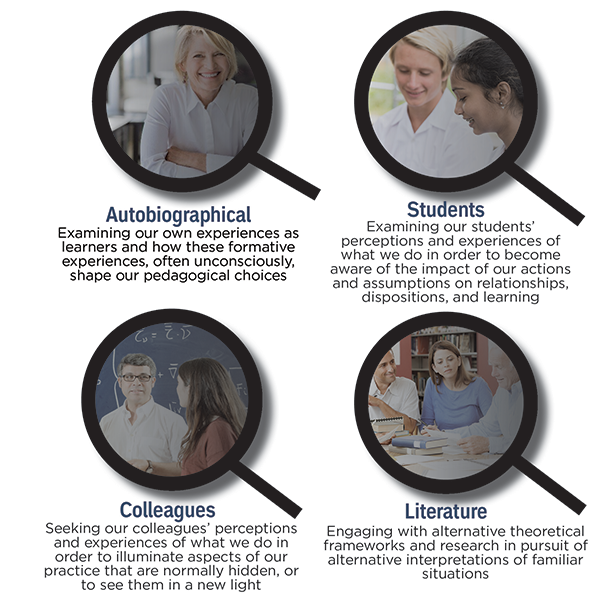
4 Education Lenses
For information on scheduling a class for your unit contact Lt. Col. TinaGay Riddle at tinagay.riddle.mil@mail.mil or call her at 502-607-1798.
Strategic lenses are a concept of strategic management. They are the four angles from which strategy can be viewed and implemented on a corporate level.Overall, strategy is likely to come from a variety of sources and a combination of the above techniques. Johnson and Scholes talk about 'strategic lenses', which are three ways of viewing what can be meant by the term 'strategy'
4 Lenses Assessment
Views[edit]
The four viewpoints are: as design, as experience, as ideas, as discourse.
Strategy As Design[edit]
This lens views Strategy development as a process of logical determinism. Through careful evaluation of the firm's industry, environment and available resources, the optimal strategy and clear direction can be determined.[1] This strategic process thus follows an analysis-selection-implementation process.
Fundamental to this view is that the responsibility of strategy development is top-management driven and that they are capable of choosing the optimal strategy for the business.
Strategy As Experience[edit]
4 Educational Lenses Review
Many proponents of the view of Strategy As Experience, such as Mintzberg would argue that the design lens is often inaccurate as top level executives are too distant from daily developments of the organisation.
According to Minzberg, strategic development should be adaptive, and divides it into intended, realised and emergent strategies.
In this model, strategic development is the continuous adaptation of past strategies based on experience.[1] In this view strategy is greatly influenced by taken for granted assumptions (culture) and involves large levels of bargaining and negotiation.Strategy as Experience carries with it a risk of the effect known as strategic drift as a result of failing to act upon environmental changes by being too 'path dependent' on past activity.
Remember the 4 lenses are a theory of strategic management.
Strategy As Idea[edit]
This approach to strategy emphasis innovation and the need for diversity of ideas in the organisations. Strategy can emerge from the way people within the organisation handle and respond to the changing forces present both in the organisation and in the environment. Support of this view argue partly by analogy with evolutionary theory, suggesting where there is diversity of approach, a change in environment conditions is likely to be accommodated by one of the various methods, products or system already existence.
4 Educational Lenses Model
Strategy As Discourse[edit]
This view consists in making choices between different possibilities and then inspiring confidence for the choice taken. This view is very high on legitimacy and low on rationality and innovation. Strategy as discourse sees strategy development in terms of language as a 'resource' for managers by which strategy is communicated, explained and sustained and through which managers gain influence, power and establish their legitimacy as strategists.
Johnson and Scholes suggest that viewing strategy through only one of these lenses can mean that problems that the other lenses might show up are missed. For example, too much reliance on incremental changes (strategy as experience) might overlook radical new developments that could be essential for the organisation's success (strategy as ideas).
It is worth considering the very strong influence the design and experience lenses have in large organisations and government departments. Often, the larger the organisation, the less able it is to adopt early essential but radical changes.
References[edit]
- ^ abNideborn, Joakim; Kristina Stråhle (December 2007). 'Where Is the Semiconductor Industry Going?'(PDF). Retrieved 2008-09-27.
4 Lenses Test
Johnson Gerry / Scholes Kevan / Whittington Richard: Exploring Corporate Strategy. 8th Edition, Pearson, 12/2007, S. 29 - 46
4 Educational Lenses Free